Ditto CEO Gonzalo Alonso in ABC: why passwords are no longer enough

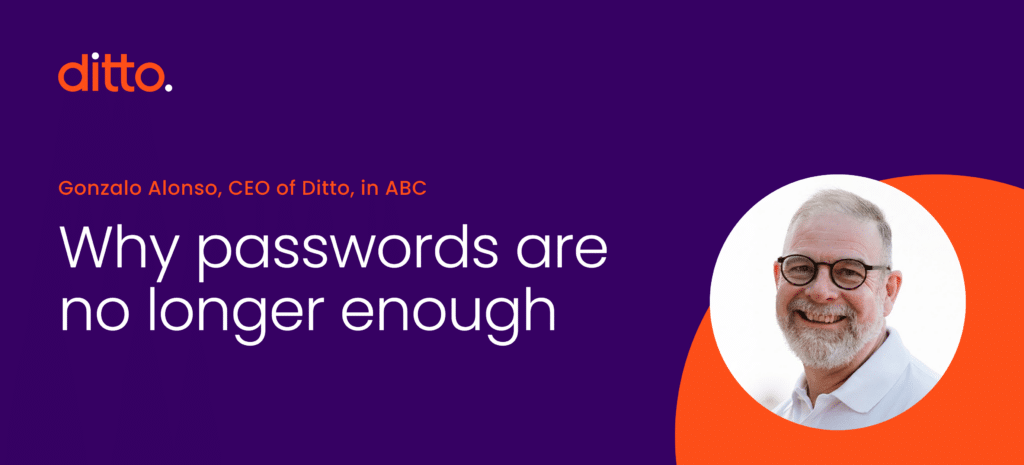
In an interview with ABC, Gonzalo Alonso explains why most attacks now start with a login rather than a breach, and why organisations will need to hold less personal data in the years ahead.
Ditto CEO Gonzalo Alonso has spoken to ABC, one of Spain’s leading national newspapers, about the state of digital identity as cyberattacks rise and AI accelerates fraud. The interview was published on 31 October 2026.
The full interview is in Spanish and you can read it on ABC. Here’s a quick summary in English.
Identity as a set of signals
Alonso defines digital identity not as a person’s online self, but as the collection of signals that tells a service whether someone is entitled to act. Those signals vary in strength. Biometrics are highly deterministic, while a name is weak because many people share it. The signals that matter in banking also differ from those that matter in healthcare.
Not breaking in, but logging in
A central theme of the interview is that most incidents no longer involve anyone breaking into a system. Attackers log in with access they have already obtained, whether through a compromised password, misused technology or a device that has changed hands.
Each breach adds to the picture fraudsters hold of an individual, until they have enough to deceive a bank. Alonso pointed to cases in Latin America where young people opening their first bank account at 18 discover one already exists in their name, with credit attached. Lists of personal data, he noted, sell online for as little as ten cents.
“Passwords no longer work. They aren’t enough.”
— Gonzalo Alonso, Chief Executive Officer, Ditto
AI on both sides
Alonso acknowledged that agentic attacks are operating at speed and scale, but stressed that defenders are responding in kind and increasingly preventing attacks rather than reacting to them. He described real-time monitoring Ditto developed to detect an emerging pattern and isolate it before it consolidates, a capability built over the past year as AI agents became a genuine threat.
Toward reusable credentials and minimum data
Looking ahead, Alonso sees the future in reusable biometric credentials held in identity wallets, the model Europe is adopting, where parties exchange cryptographic proof rather than the underlying data. He expects adoption to take time while legislation and institutions adapt.
In the meantime, holding personal data with no practical use is becoming a liability. EU regulation is set to push organisations to retain less, and enforcement carries reputational as well as financial cost. In his view, the banks that succeed will be those that earn the most trust.
What organisations should do now
Alonso’s advice starts with honesty about existing weaknesses, noting that security is too often treated as an add-on rather than a platform. Organisations should partner with technology providers who understand their use cases, and move quickly on regulatory requirements and their highest-risk transactions. He was also candid about the barriers: change is hard, budgets are limited, and sometimes the will is missing.
Ditto’s approach, as Alonso outlined, is to protect the device, the user and the transaction, so organisations know who they are dealing with and the outcome cannot be disputed.
Read the full interview on ABC (in Spanish), along with more on Ditto ID.
About Ditto
Ditto is the Identity and Access Management platform that replaces fragmented identity stacks with one Trust Stack: mobile app protection, identity verification and risk-based authentication, sharing signals across a single integration. Continuous, verified trust. Minimum data. Ditto’s technology secures over one billion devices, verifies over one billion identities and authenticates billions of interactions for regulated organisations worldwide. Headquartered in Barcelona, Spain. ditto.id

Enjoyed this article? Share it.