The Art of Digital Identity

After Ditto’s “Art of Digital Identity” live experience, we explore how selective disclosure, EUDI and interoperable digital identity are reshaping trust.
The Art of Digital Identity
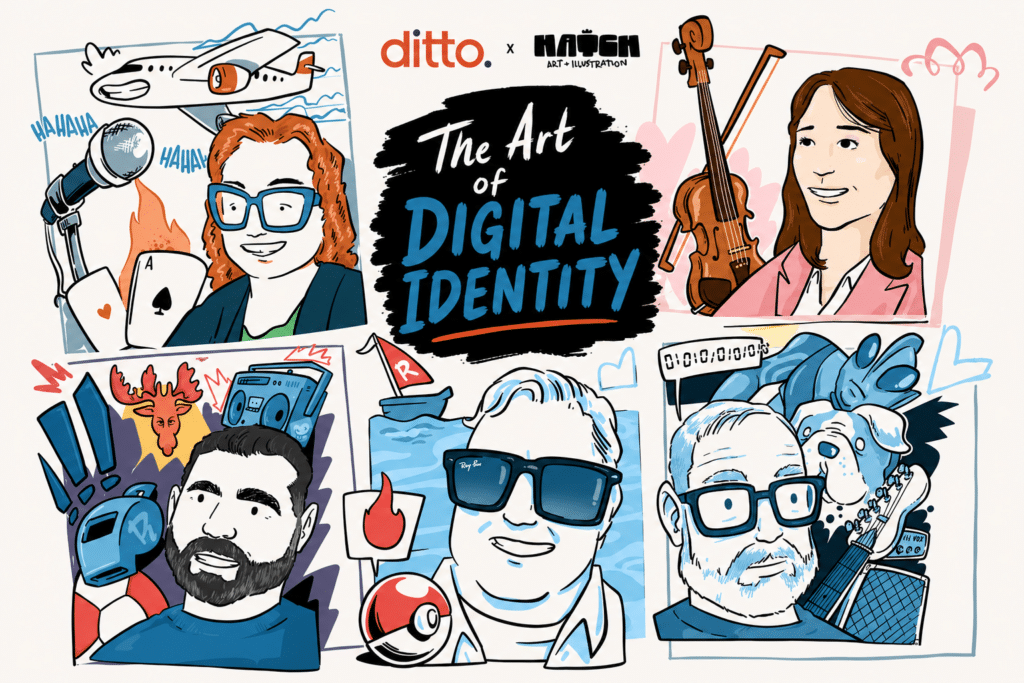
At the recent Identity Week event, we asked delegates to do something simple: selectively disclose who they were.
Not everything. Not the full picture. Just the details they wanted to share.
Those chosen details were passed to Hatch, an award winning artist and illustrator, who transformed each person’s inputs into a digital identity portrait. The result was creative, personal and memorable. It was also a useful reflection of where identity is heading.
Because selective disclosure is not just part of a clever brand experience. It is becoming one of the defining ideas in digital identity.
For years, identity checks have required people to hand over more than necessary. Full names. Dates of birth. Addresses. Documents. Copies of documents. Static data has been collected, checked and stored, often to answer a much narrower question: is this person who they say they are? Are they old enough? Are they entitled to access this service? Can this transaction be trusted?
That model is changing.
The art of digital identity is evolving from broad disclosure to precise proof. From repeated checks to reusable credentials. From organisations collecting data by default to individuals sharing only what is needed, when it is needed, with consent and control.
EUDI has brought this shift into sharp focus. The EU Digital Identity Wallet is designed to give citizens, residents and businesses a safe, private way to identify themselves, store and share digital documents, and access services across borders. EU guidance also defines selective disclosure as a way for wallet users to share only the specific information requested, without revealing additional personal data.
But this is not only a European story. As EUDI takes shape, other territories and jurisdictions are watching. The question is no longer whether digital identity changes. It is how quickly different markets adopt the principles behind it: interoperability, privacy, user control and trust that travels.
Successful identity players need to support that world. Not one wallet. Not one jurisdiction. Not one isolated use case. They need to help organisations operate across different schemes, standards and markets, so customers can prove who they are wherever the interaction happens.
That shift changes what digital identity checks need to do.
Whereas traditional identity checks were built around static snapshots: collect data, verify it, store it, and ask the customer to repeat the process next time, the future of identity will be more dynamic, shaped by a myriad of fluid, contextual parameters and with privacy at the core.
Wallet-based identity and verifiable credentials will allow people to prove something specific about themselves without exposing everything about themselves. Identity becomes less about handing over data, and more about sharing trusted proof.
And at the centre of it all is one purpose: mutual trust.
An organisation needs to know it is dealing with the right person. The user needs to know the organisation is legitimate, the interaction is secure, and their personal information is respected. Trust has to move both ways.
And it cannot be a one-off moment.
Onboarding matters. Login matters. But digital trust does not end once an account is created or a session begins. It needs to be continuously validated across the full journey: the user, the device, the credential, the channel and the transaction.
That is where digital identity gains real depth. It becomes the ability to paint a trusted picture of any interaction, at any moment in time.
The Art of Digital Identity may have started as engaging event activation, but the message behind it is bigger.
Identity is becoming more personal, more private and more portable. Control is moving back to the user. Certainty is becoming continuous. And the organisations that get this right are not just reducing friction or meeting compliance demands.
They are creating the conditions for trusted digital relationships that can move across borders, markets and moments.
That is the artform.

Hi I'm Matt! I've 20 years of experience in identity, mobile intelligence and fraud prevention solutions, and am working with Ditto to build the next generation of identity.
Enjoyed this article? Share it.